Parsha Emor
Emor means ‘To Speak’. Who was speaking to who?
Last week’s Parsha was what the Jewish nation should do to become a Holy People. This week Hashem continues to tell Moshe about the Kohanim being Holy – what they can and can’t do. The Kohanim have special commandments because they are the scholars and teachers of the Torah and had to safeguard and preserve the Torah and the commandments. The Kohanim had many responsibilities and had to have a high standard of Holy behavior and purity. They also had special laws that only applied to them about contamination. The Kohanim had to set the example to be careful and had to be role models for the rest of the people.
We also learn about the Festivals of the Jewish Calendar- the times that the Jewish people meet with G-d. These appointed times are known as ‘Moadim’ – appointed seasons. These are times when we are summoned communally to appointed activities at appointed times (Moed). The Moadim interrupt the ordinary activities of our lives, and give us time to dedicate ourselves spiritually and physically to Hashem.
The Moadim listed in this weeks Parsha are:
–Shabbat,
–Pesach,
-Bringing of the 1st barley harvest, the 49 days of Counting the Omer, ending on the 50 th day- Shavuot
-the Shofar on 1st Tishrei-Rosh Hashana
– Yom Kippur- the Fast day on the10th Tishrei,
– and Succot on 15th Tishrei.
The main one we will focus on this week is the period from Pesach to Shavuot- The Omer.
What is an Omer ?
1)The Omer (Hebrew: עֹ֫מֶר ‘ōmer) is an ancient Israelite unit of dry measure used in the era of the Temple in Jerusalem. It is used in the Bible as an ancient unit of volume for grains and dry commodities, and the Torah mentions as being equal to one tenth of an ephah. An ephah measures out to 92.99 cup. An ancient Hebrew unit of dry volume measure, equal to a bath or to one-tenth of an omer. It is approximately equal to 22 litres.
An ancient Hebrew unit of dry measure, equal to a tenth of a homer or about one bushel
2) The Omer is also a period of 49 days, extending from second day of Pesach to the first day of Shavuot.
From the day on which you bring the sheaf of elevation offering the day after the Sabbath you shall count off seven weeks. Shavuot was an agricultural festival and the focus was the Temple(Mishkan).
Even though we don’t have the Temple anymore, and don’t give an omer offering, the Rabbi’s declared that we should still count the days between Pesach and Shavuot.
The Rambam (Maimonides) even said that the commandment for us to count today comes directly from the Torah. Kabbalists (mystics) explained that the Omer period is there as a preparation for receiving the Torah on Mount Sinai (Har Sinai). Counting the Omer is a time of contemplation (thinking about things) and meditation of how we can improve ourselves, and renew our spirits in preparation for Shavuot. There are 49 days until Shavuot, divided into 7 weeks, and each week has a theme to focus on, and the combination of the 7 attributes of G-d. Each day of 49, is a combination of 2 attributes. The counting of the Omer serves us as a link between Passover and Shavuot. It reminds us that we are free men and women and we should not consider ourselves slaves anymore . We must work hard on ourselves to better ourselves and and build up good strong characteristics so that we can be ready to receive the Torah on Shavuot.
The Sefirot of the Omer- making each day meaningful; These are the 7 emotional attributes.
1. CHESED : Overflowing Loving kindness – Week 1,
2. GEVURAH : Judgment, Restraint, Justice, Rigor-Week 2
3. TIFFERET: Harmony, Compassion, Beauty, Balance- Week 3
4. NETZACH : Eternity, Victory, Efficiency, Prevailing -Week 4
5. HOD : Beauty, Glory, Splendor-Week 5
6. YESOD: Foundation, Intimacy, Generativity- Week 6
7. MALCHUT: Kingship, Majesty, God’s Earthly Realm- Week 7.
Each day we focus on different attributes – A combination of 2 each of the 49 days. Eg. On the first day of the counting, work on chesed within chesed (the purest love within yourself). Day two: Gevurah within chesed……When we finish counting the 49 days we arrive on the 50th day-Matan Torah- Shavuot. We receive the Torah, and the gift (‘Matan’ in Hebrew) of refining our personality traits and working on our middot ( characteristics) in order to really feel the gift of true freedom, transcend our limitations and connect to the Divine.
It’s not to late to count the rest of the Omer- (without a Bracha if you aren’t counting each day)…. Start,…it’s so worthwhile and character building…..Enjoy!
What is Lag B’Omer?
Lag B’Omer is a great day on the Jewish Calendar. It is the 33rd day of the Omer. Lag BaOmer is always on the 18th day of the month of Iyar. So what’s up with the name? The word “Lag” is made of of the Hebrew letters lamed (ל) and gimel (ג), which together have the numerical value of 33. “BaOmer” means “of the Omer.” There was a plague that caused many students of Rabbi Akiva to die, and on Lag B’Omer the plague stopped and the people celebrated. Rabbi Akiva was the teacher of Rabbi Shimon bar Yochai. The people died from the plague because because “they did not act respectfully towards each other.” These weeks of the Omer are considered a time of mourning and we don’t have celebrations- except on Lag Ba’Omer.
There are 6 Lag Ba’Omer customs and traditions that are special for this festival and their meanings:
- Light Bonfires; It is traditional to light bonfires on Lag BaOmer Eve. Rabbi Shimon bar Yochai, lived in the second century of the Common Era, was the first to publicly teach the mystical dimension of the Torah known as the Kabbalah, and he is the author of the classic text of Kabbalah, the Zohar. When Rabbi Shimon passed away he told his students to mark the date as “the day of my joy.” These commemorate the light that Rabbi Shimon bar Yochai introduced into the world through his mystical teachings. This was especially true on the day of his passing, Lag BaOmer, when he revealed the secrets of the Torah to his students. When Rabbi Shimon passed away he told his students to mark the date as “the day of my joy.” The Zohar relates that the house was filled with fire and intense light, to the point that the assembled could not approach or even look at Rabbi Shimon.’ (chabad.org)
- Go to Meron; This is the burial place of Rabbi Shimon bar Yochai. Thousands of of people flock to this site and there are all night festivities and celebrations. There is singing and dancing and celebrations around the clock.
- Shoot Bows and Arrows: This is from a midrash tradition that states that during Rabbi Shimon’s lifetime, rainbows werent seen at all because of Rabbi Shimon’s merit and what he did in his lifetime, actually protected the world, and so rainbows weren’t necessary. The Hebrew word for “rainbow,” keshet, refers to both the rainbow as well as the bow used in archery (in fact, a rainbow is called G‑d’s “bow”). To demonstrate that after Rabbi Shimon’s passing there is now a need for the sign of the (rain)bow, many have the custom to play with bows and arrows on this day. We have to remember that rainbows first appeared after Noah’s flood, and Hashem promised he wouldn’t destroy the world again, so he sent a rainbow to remind us to ‘be careful’ and improve our ways and our actions. The bow and arrow teaches us a very important lesson about respect and how one can reach the great heights. In order to shoot an arrow, one needs to pull the string of the bow. The further back the string is pulled, the farther the arrow can fly. It is parallel to the idea that if we pull back our own ego’s and recognizing G‑d and His wisdom is the ultimate heights to recognize and reach, then we clear the path to reach greater heights for ourselves and not limited. This is an interesting and deep idea. The Zohar tells us that before the coming of the Moshiach, an especially bright rainbow will appear in the sky, heralding the coming redemption.
- Go to a Lag Ba’Omer Parade, (in your city). The Lubavitcher Rebbe encouraged the practice of arranging children’s parades on Lag BaOmer in celebration of Jewish unity.
- Eat Carob – reminding us of the miracle of the Carob tree that was outside Rabbi’s Shimon’s cave that he lived in for many years. Rabbi Shimon and his son ran away from the Roman rule and hid in a cave in the north of Israel for 13 years. The Carob from the Carob tree was the food that nourished Rabbi Shimon and his son while they were in the cave.
- A Celebration Day of Joy. All the strict mourning Omer practices stop on Lag Ba’Omer.It is a day where we are allowed to have weddings, haircuts, music and more. It is a custom for many to take young boys of 3 years old, who’s birthday was during the Omer perid, to Meron for their first haircut (Opsheren)
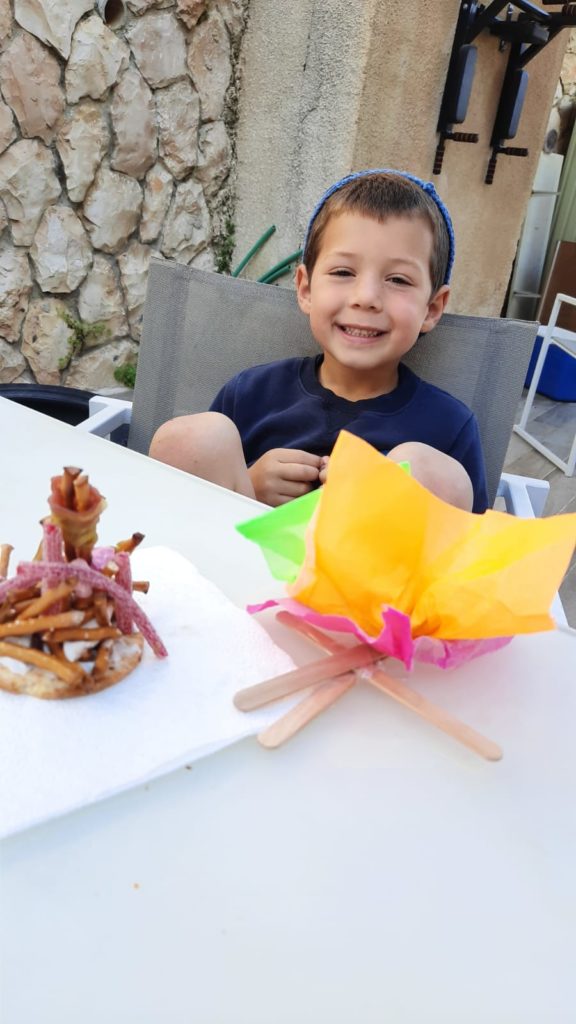
FUN ACTIVITIES – CELEBRATING LAG BA’OMER– Easy Crafts
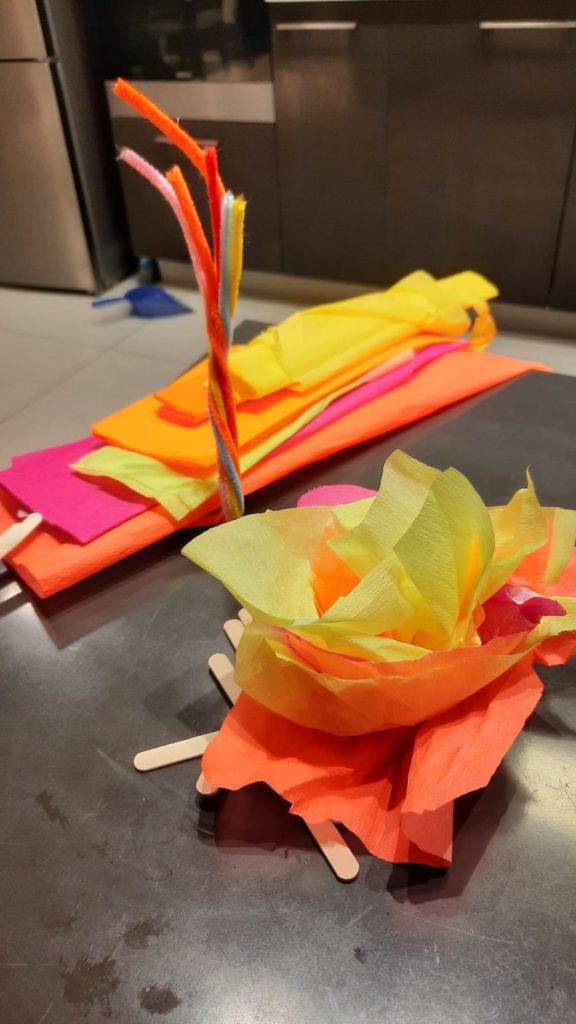
Make a Fire with Tissue paper or Crepe Paper.
Use ‘fire colors- Orange, pink, red, yellow and orange ( can add green/blue). Cut squares , circles of Paper, put different colors – one on another.
Staple it in the middle, use a ‘thumb tack’, or safety pin (something to hold it together)
Start from the first color, scrunch it up towards the middle so it stands up, and work your way through the other colors.
Use paddle pop sticks to assemble it on- the ‘wood’ for the fire.
A fun activity for everyone.!
FUN FOODS
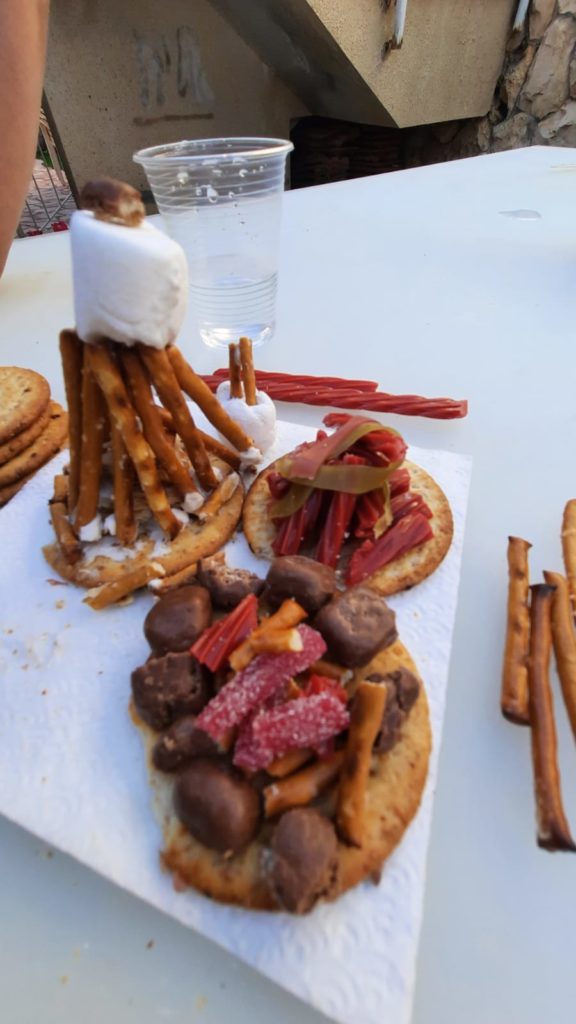
Make an ‘edible’ Fire- sweet or savoury. Think creatively!
Ingredients; Savoury ‘Fire– A Round cracker, grapes cut in half (preferably black grapes, green will do too)
Spread on the cracker (cream cheese, lotus, spread, peanut butter or even chocolate spead!) This is the ‘glue’ to build up the fire.
Pretzels- long thin stick pretzels, ( the wood) Yellow cheese for the flames . Sweet ‘Fire’- Round cracker, spread, chocolate nibs/ biscuits around the cracker leaving the middle open. ‘cigar biscuit rolls to build up the fire, Pretzels wrapped with friut sticks for the flames, or red ‘sour sticks, or red licorice. and marshmallow pieces on top – attached to pretzel sticks (see pictures- which explain everything.)
Be creative!
Wishing you a great Lag Ba’Omer, a meaningful counting of the rest of the Omer, and may we merit to see the bright rainbow in the sky, to let us know that Moshiach is on the way…. speedily in our days.
Shabbat Shalom from Safta Laya.