Parsha Shemini with Safta Laya
Parsha Shemini – Pesach time 2021
Short summary of the Parsha;
Aaron and his sons begin to officiate as kohanim (priests) on the 8th day. They offer Korbanot ( sacrifices) on the altar ( Mizbe’ach) and G-d consumes the offerings with fire. Hashem’s Divine Presence comes to dwell in the Sanctuary. Aaron’s two elder sons, Nadav and Avihu, offer a “strange fire before G‑d” and they die, because G-d didn’t ask them to offer anything extra. Aaron is silent in face of his tragedy.
G‑d tells the people about the laws of Kashrut (kosher laws)- which animals to eat and which we cannot eat. Hashem explains that we can only eat animals with split hooves and that also chew their cud. All fish we eat must have fins and scales. We also learn about which birds are kosher. In the Parsha it also mentions the mikvah and some of the laws of ritual purity. Towards the end of the Parsha, it explains that Hashem wants his people to be holy, because He is Holy. G-d wants the best for His people. He wants them to be pure and holy so they will be eternal, and perceive their Creator and follow in His path (Sforno). Hashem is telling us how to be a holy nation. Only if we listen to the commandments, eat kosher food, and learn what the difference is between pure and impure, then we strive towards holiness and appreciation of G-d and what he has given to us.
Why eat Kosher food?
What is the big deal? Eating is an instinctual activity, and a mechanism for survival on earth. Judaism understands that every human being has a body and soul. The body houses the soul, and we feed our bodies in order to keep our soul alive- so eating is physical and spiritual. Keeping Kosher gives the physical act of eating, a spiritual meaning. By following the Torah’s guidelines of Kashrut, when we eat food, we tame our animalistic instincts, and train ourselves to have more spiritual desires. We strive for Holiness (Kedusha) which helps refine our personality traits, and have a relationship with G-d. We chose to eat ‘holy’ food to feed our souls as well as our bodies. Food doesn’t only affect how we feel physically. Our diet affects our mood, our mental state, and our wellbeing. It also affects us spiritually. We strive for a closer connection to G-d, and so eating forbidden foods might put a barrier between a person’s soul and their connection to G-d. Kosher food has a spiritual quality and when we eat it, we nourish our bodies and souls.
Parsha Shemini looks at Kashrut – We will learn a little about Kosher Fish
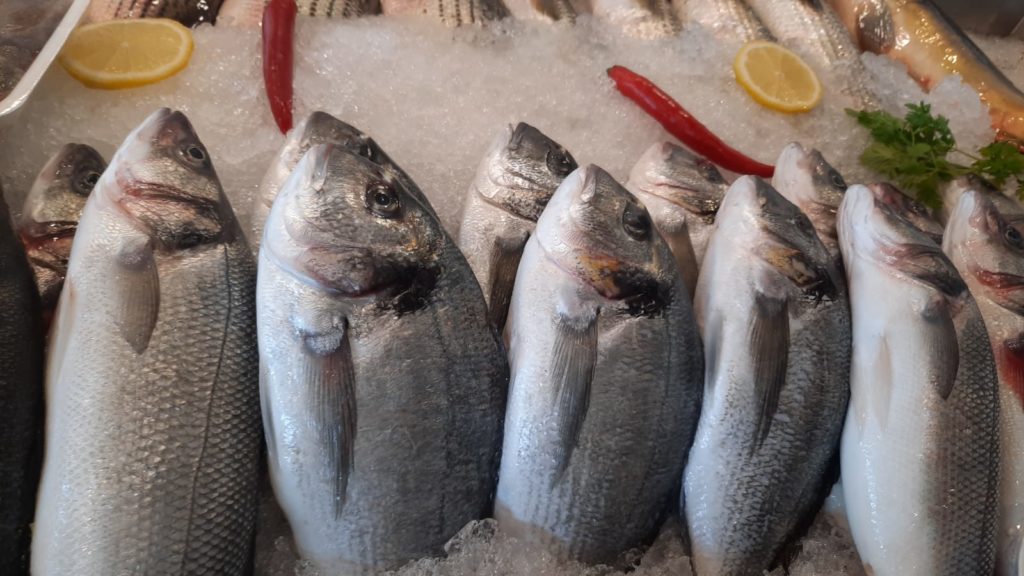
“This may you eat of all that is in the water, everything that has fins and scales” (Vayikra 11:9). Our sages in the Talmud state that every fish with scales also has fins (Chullin 66b). Scales have since become the single determining sign for kosher fish. And so the only criterion for fish to be kosher is that it have both fins and scales. Fish does not have to be slaughtered or salted as do meat and fowl. Kosher fish include cod, flounder, haddock, halibut, herring, mackerel, pickerel, pike, salmon, trout, and whitefish. Non-kosher fish include swordfish, shark, eel, octopus, and skate, as well as all shellfish, clams, crabs, lobster, oyster and shrimp.
What are scales?
Biologists sort them into five types of scales: Placoid, Cosmoid, Gadoid, Ctenoid and Cycloid. However, according to the Jewish Code of Law, scales are fingernail-like protrusions on the skin. They are detachable and, when detached, no damage is caused to the fish. There are some types of fish that have scales, including sturgeons, sharks, eel, etc., that are not considered kosher since their scales are embedded, and when removed damage the skin (Ramban Shemini, Nodeh B’Yehudah 10:28). Kosher certifying agencies are constantly reevaluating the status of new fish on the market, since not all scales are kosher scales.
Fun Fish Activities:
- A visit to the Market/ Shuk to look at different kinds of fish, and identify ‘kosher’ fish (with scales and fins)/
- An afternoon at the aquarium – looking at the underwater world.
- Drawing fish and coloring in different fish.
- Looking at books on Fish.
- Reading story books about Fish (Toddler). Whale of a tail stories.
- Fishing in lakes/ sea and what you need to catch a fish….A visit to the beach (in good weather!)
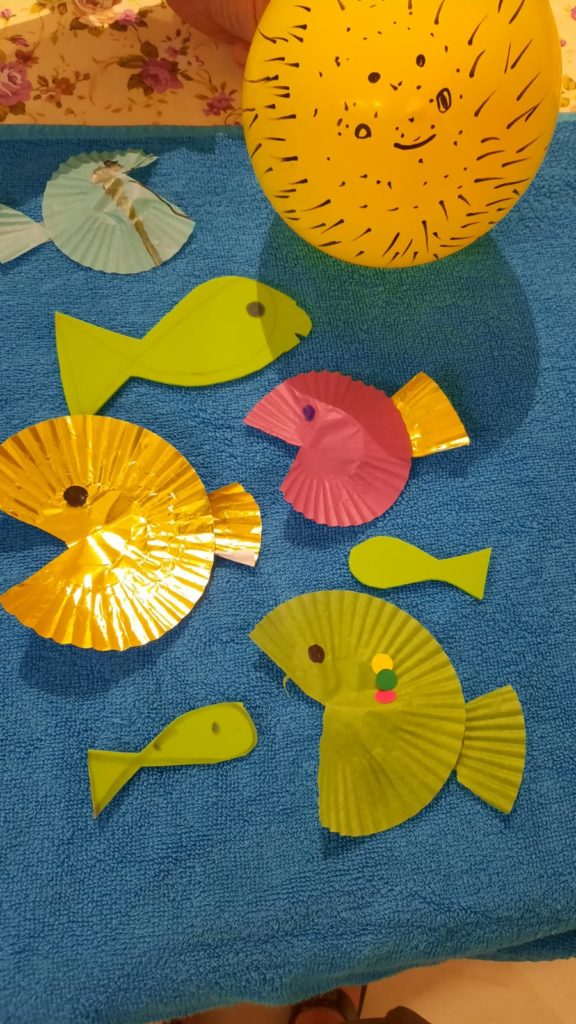
- Being creative with arts and crafts for younger kids:
Take a paper plate: cut a 1/4 out, color it in, draw scales, or collage it and stick scales on the plate.
Draw an eye and use the cut out for a back fin. - Colored Cookie cups:
flatten them out, cut a ‘triangle out of it, and use as a back fin (stick on with glue).
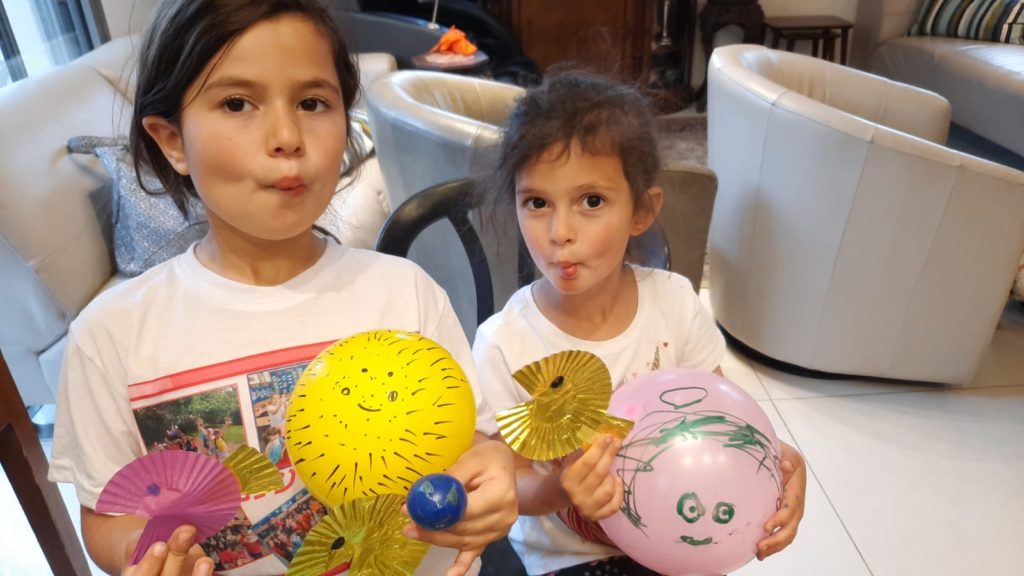
Draw and eye and ‘voila’- a fish! (see pictures)
This is great for discussions about Kashrut especially Kosher Fish at the Shabbat table.
Sefirot Ha’Omer
This is the week of Gevurah. There are many terms used to translate Gevurah. It is Restraint, Discipline, Judgement, Boundaries. It helps us concentrate our efforts and directs us in the right direction. It gives us focus and helps us ‘check in’ for excessiveness and effectiveness in all aspects of our lives, eg; health, food, accomplishments, organization, interactions, discipline… and more.
Shlissel Challah this Shabbat!
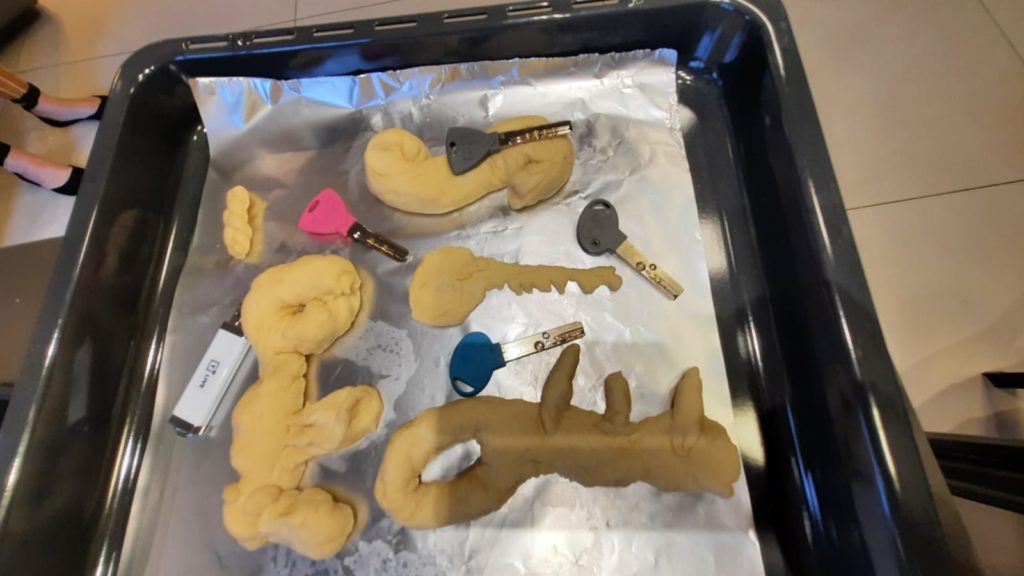
There is the tradition, or minhag of baking a special type of challah for the first Shabbat after Passover. Made either in the shape of a key or with a key baked inside, the special bread is known as shlissel challah, with shlissel being the Yiddish word for “key“.
The making of this particular shape or style of challah is considered by those who bake it to be a segula (ritual or good omen) for parnassa (livelihood). Why? There are many reasons, sources, and histories that highlight this uniquely-styled bread for Shabbat.
To quote the Sefer HaTodah by R’Eliyahu Kitov: “The Shabbat after Pesach when we announce the coming of Iyar… some have the custom to make challah in the form of a key and to sprinkle it with sesame seeds. This is to remind us of the Mahn [manna] that began falling (in the desert) in the month of Iyar; it also symbolizes that the ‘key’ to our parnassa [livelihood] is in Hashem’s hands. We pray that Hashem will …shower us with abundance. ”Sesame seeds are used to depict ‘mann’ as they are small and white as it says about the ‘mann’- “they were like small seeds, white, and [tasted] as if they were dipped in honey.”
Safta Laya’s Famous Foolproof Challah Recipe
I use the same basic recipe for White Challah, Wholewheat, and Spelt Challah with Date Syrup (no sugar). I use enough flour to say a Bracha. The bread freezes very well, and when warmed on Shabbat tastes really fresh and delicious.
Ingredients- for White Challah
- 40 grams of fresh yeast, with 1 tablespoon of sugar, in 1 cup of warm water- place in a bowl and wait for the yeast to bubble ( approx. 10 min)
Important tips; Active yeast comes in a package of 2 blocks. Each block is 25 g. I cut approx. 10 grams off the one block. Crumble the yeast into a bowl, add sugar, and warm tepid water and and leave it until it bubbles. Water shouldn’t be too hot- it will kill the active yeast.
- 10-14 cups of Flour (approx. 2 ¼ ,½ kilo’s-)
- 1 cup of sugar
- 2 Tablespoons of Salt
- 1 cup of oil
- 2 eggs
- 3 cups of warm water
Method;
Place 6 cups of sifted flour into a Kenwood/mix Master mixing bowl, add salt and sugar. When the yeast is bubbling, pour it into the flour mixture. Add another 3 cups of warm water. Use a ‘K’ beater to mix the flour and water together until well blended.
Add 1 cup of oil, 2 eggs and continue to mix well. Slowly add the rest of the flour (approx. 6 more cups of sifted flour)- add more flour if it is too sticky.
Pour the dough into a large basin. Knead it with your fists and hands until well blended. Punch it down well.
Cover the basin with a towel and place it somewhere to rise (not in a drafty place- it needs to be in the kitchen, in light, warmth).
The dough will rise within 2-3 hours. Punch it down. (It can also rise overnight if it works for you)/ Punch it down after it has risen. Knead it well.
Break it up into small balls, knead and then braid it, or shape it . Brush with egg, add seeds- sesame, poppy seeds, sunflower seeds, pumpkin seeds, flax seeds, caraway seeds, zaatar.
Bake in a hot oven ( approx. 200 degreeC / 400 F) until Challah is golden brown on top and baked at the bottom (check under the challah).
Spelt Challah with Date Syrup
Same quantities. Replace sugar with 1 cup of Date syrup. – delicious and light. I often combine white spelt/ 80 %/ and 100% spelt together. It’s best to put the oil in a cup and add the date syrup , and pour it into the mixture at the beginning of the recipe, with ½ flour and yeast and mix together well before you add the eggs.
Before 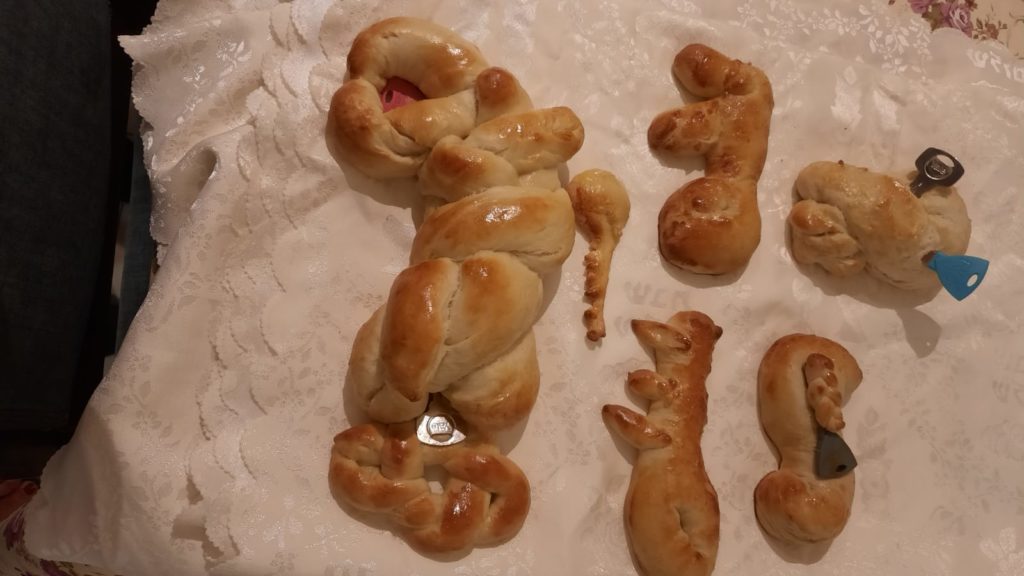
After
Separating the Challah
(with over 2.25 kilo’s of flour)
Take a small ball of Challah, the size of a ‘kezayis’ (ie half a standard egg).
Place this in 2 small pieces of silver foil (double wrapped). Say the blessing before you put it into the bottom of the oven to burn it.
Recite the following blessing:
‘Baruch ata Hashem Eloheinu Melech HaOlam Asher Kidishanu be- Mitzvah tav Vetzeevanu Lehfreesh Challah min Ha-Isah.‘
Baking Challah is an effort and yet worth the smell taste, of homemade delicious challah for Shabbat. Baking it in a shape of a key, or putting a key into the challah is a fun activity and promotes great discussions too. Don’t be intimidated…be bold and try it- it’s fun too.
Shabbat shalom from Safta Laya!
Thank you for all the wonderful ideas we can do with our kids! I love your blog it’s chock full of information, look forward to next week.