
Parsha Behar- Bechukotai-new
This is a double Parsha – Behar and Bechukotai.
In Parsha Behar we learn about the laws of the Shmitta year, when the Jewish people entered the land of Eretz Yisrael. Every seventh year is a rest year, a Shabbat for the land. Shmitta means to ‘let go’. The Shmitta year reminders us that God is in charge and it is really Him that feeds us and not the land. The year of Shmitta builds up our ‘Emunah’, our trust and belief in Hashem. We understand deeply that Hashem watches over us, protects us and every individual and we are dependent on our Creator. Shmitta only applies in Eretz Yisrael. The Shmitta year starts on Rosh Hashana of every seventh year. For the entire year, farmers can’t plant or sow seeds, or plow or work the farmlands in Eretz Yisrael. The only work he can do, is water the plants enough that they don’t die. Fruit trees grow the fruit and the farmers are not allowed to sell these fruit. They have to declare the trees ‘Hefker’ -public property. This means that anyone can come and pick the fruit off these trees. The farmer has to keep the gates to his farm open so anyone can come and pick fruit if they wish. We also learn that at the end of the Shmitta year, you don’t have to pay back loans. Every fiftieth year is a Yovel Year, or Jubilee Year. The Parsha also talks about looking after our own people and helping them out of the poverty cycle.
The final mitzvah of Bechukotai is for a farmer to give a tenth of his cattle to God. If a Jewish farmer raised cows, sheep or goats he has a mitzvah to give every tenth new born animal to God. This mitzvah is called “Ma’aser Behaima.
In this week’s double Torah portion, Behar-Bechukotai, we come across the following phrase:
“If you shall walk in My statutes…” (Leviticus 26:3) Rashi explains what it means to “walk” in the ways of God’s statutes. He suggests that “walking” here means that we must “toil in the Torah, ‘shetihyu ameilim baTorah.”
Rabbi Lord Jonathan Sacks expands further on this idea and talks about the blessings and curses in these Parsha’s. He says there are many more curses (in strong language) than blessings. Vayikra draws to a close by outlining the blessings that will follow if the people are faithful to their covenant with God. Then it describes the curses that will befall them if they are not. The general principle is clear: In biblical times the fate of the nation mirrored the conduct of the nation. If people behaved well, the nation would prosper. If they behaved badly, eventually bad things would happen. So, the conclusion is to ‘Walk in the ways of Hashem’ to receive blessings.
COUNTING THE OMER
Why DO WE COUNT -1 to 50 and not 50 to 1? Usually when we count the days to an important event in our lives we don’t usually count up, we usually count down. We would say, “Only twenty three more days until my holiday!”
Why with the Omer do we count up from one until forty nine? When the Jewish people left Egypt we are told that they had sunk to a very low level of spirituality. They needed the next fifty days to grow in spirituality step by step in order to be able to receive the Torah. Each day they grew a little more and this is why when we count the Omer. We count upwards and add a higher number each day. The Talmud tells us that the Omer is a time in which we should all be reflecting and growing spiritually. Like the Omer, solid growth is characterised by one small step at a time. If we try to conquer everything at once we won’t reach our goals- its often too overwhelming. This week is Yesod- Foundation. It is the channel between heaven and earth, and allows us through our actions , to bring Kedusha (holiness) from above to below and gives each individual to change the world to make it a better place.
This week we celebrate Yom Yerushalayim, celebrating the freedom of our beloved ‘City of Gold’. Jerusalem was recaptured from the enemy, and only when Jerusalem was in the hands of the Jewish nation, was it able to grow and flourish. We read about the blessings in Parsha Bechukotai (26:7-8), and how if we keep the covenant with Hashem, He will show us ‘favor’ and Bless us. The rains will fall in the right season, there will be peace and blessings. Jerusalem has been physically and spiritually rebuilt. There is so much progress and Torah is flourishing. We celebrate this important day on Sunday Evening (9th May). Jerusalem is the religious and political center of Israel. Jerusalem affects people in many ways. There is a special ‘Kedusha’ /holiness that one feels when in Jerusalem, and it’s also a place for everyone to unite. There are so many different types of Jews from different cultures, traditions, and backgrounds. In Tehillim 122 it says “ירושלים הבנויה כעיר שחוברה לה יחדיו”. Jerusalem is described as a city that connects the nation. The Malbim explains that we are all parts of one body and Jerusalem is our heart. We need to appreciate the fact that we live in a time where we can all be together to celebrate this special day on Yom Yerushalayim.
FUN ACTIVITIES- ARTS AND CRAFTS
We talked about ‘Following in the Footsteps’ of Hashem’s laws and Torah to increase the blessing, and avoid the curses. This week we are being intentional and thinking about our ‘Feet’, the walk, the path to follow. The theme is ‘Footprints’.
There are a number of great opportunities to look at our feet and appreciate them for what they do for us- carry us from one place to another. Hold our bodies firmly upright, connect us to the ground and more. (‘Feet on the ground’, feeling ‘grounded’)
We have a lot to be grateful for, when we think about our feet.
‘Appreciating Feet Activities’:
Remove your shoes, Trace around your foot on a paper and color it in. Step in some prepared paint and make a footprint on paper and notice how it comes out and what part of the foot actually touches the ground. Put ‘generational feet’ together on paper for a keepsake, Grandmother’s footprint, Mom, grandaughter.
Footprint keepsake:
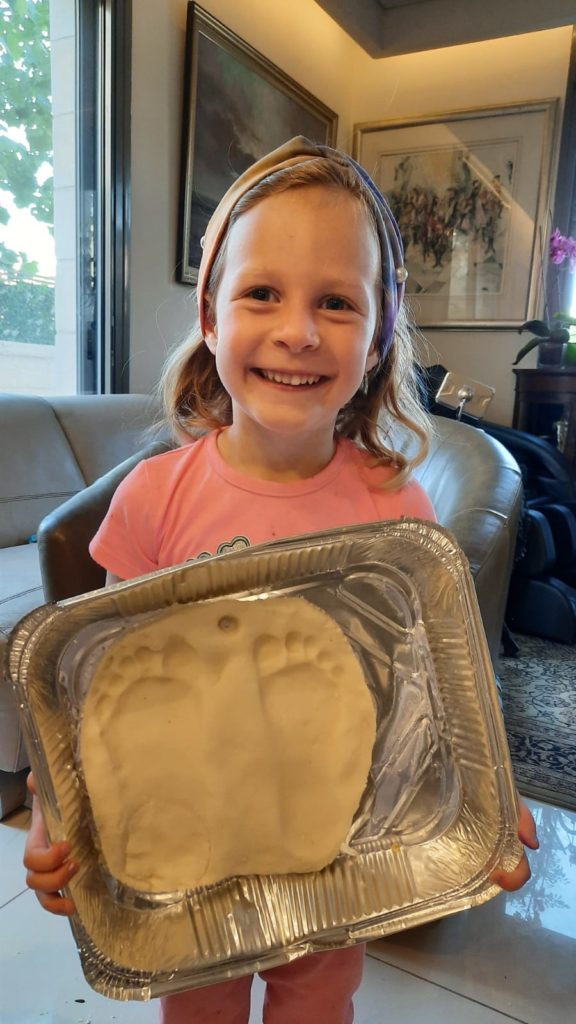
Put a footprint into a Salt dough, – either sun dry it and paint it or bake it in the oven. You can even hang it on the wall ( a great reminder to ‘walk, tread carefully…’) – a great Fun activity to do!
Salt Dough Recipe ;
1 cup flour, 1 cup salt, 1/2 cup water.
Mix salt and flour in a large bowl, Make a well in the middle, add water .
Mix together and and knead until smooth and shape into a ball.
If you want to colour the salt dough, add a few drops of food coloring while you need it. Flatten out the dough, roll it, make a round or square shape. Then place your foot onto the dough to make the footprint. It’s optional to make a small hole at the top of the dough to put some string through it and hang it on the wall, once it has dried. You can bake it in a hot oven until dried out (approximately 200 F for 45 min- 1 hr) or sun dry it. And/or you can paint the footprint after it has dried.. A great reminder to ‘Walk in the way of Hashem’, run to do a mitzvah.

FUN FOODS
Ma’asei Beheima. Every 10th sheep has to be given to Hashem for the Mizbeich/ sacrifice. This is the last mitzvah mentioned in the book of Vayikra (as explained above)
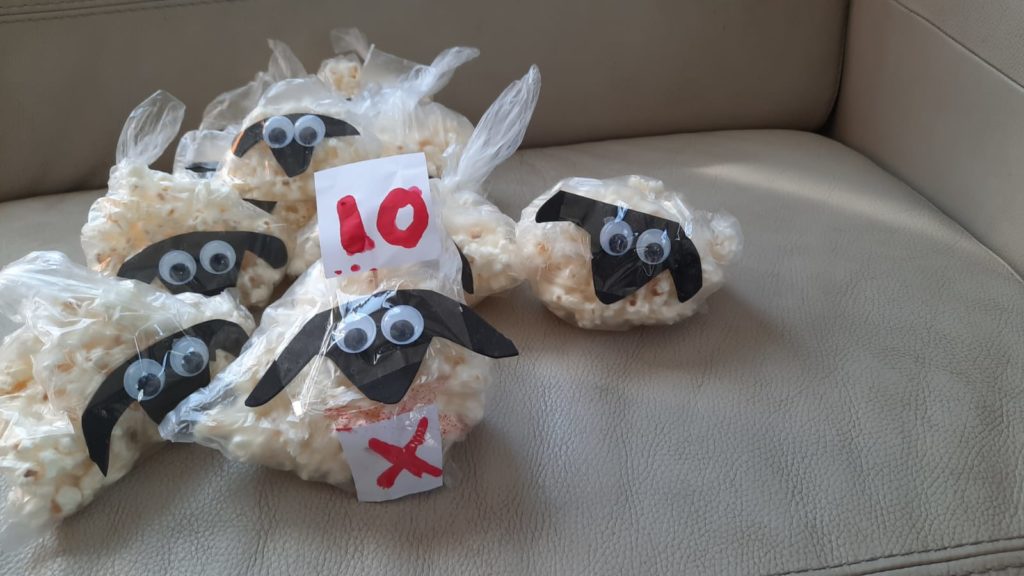
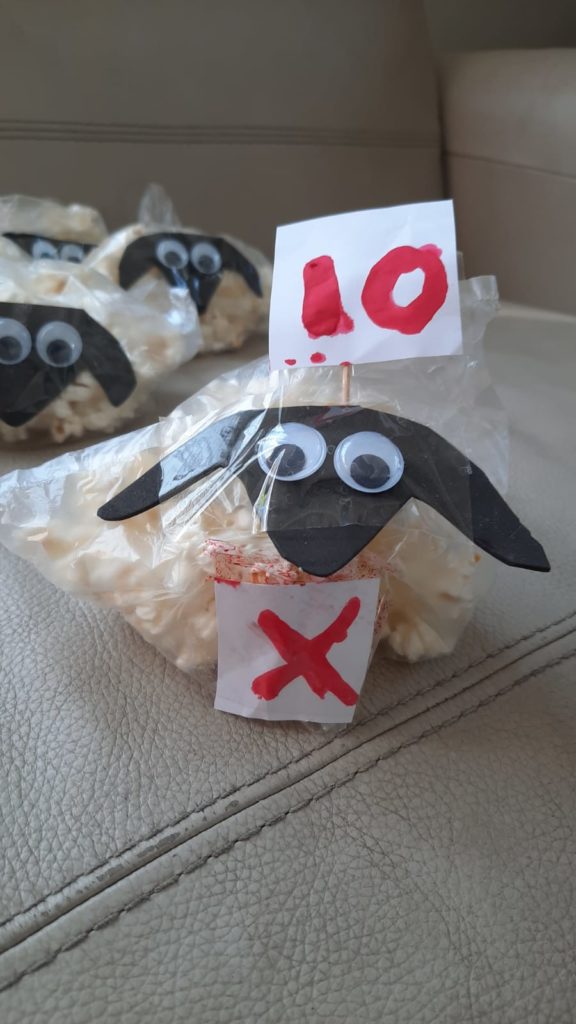
Popcorn Sheep – 10 bags, – for family members and friends and the 10th one is marked and labelled Number 10 .-Not to be given out, rather kept aside- to think about the mitzvah of Ma’asei Beheima.
Place popcorn in small bags. Cut out sheep heads and either draw or glue google eyes on the sheep’s head (See pics)
SONG:
In the Shmita year, as discussed above, farmers and their families need to put their trust in God that He will provide for them. The song below is probably well known to the children and talks about Hashem being everywhere. (To hear the tune, check it out on ‘Youtube’.) The children can insert actions.
‘Hashem is here ,Hashem is there, Hashem is truly everywhere, Up, up, Down, down, Right, left and all around, Here, there and everywhere, That’s where He can be found’
Shmitta Cake– to try and understand the laws of Shmitta.
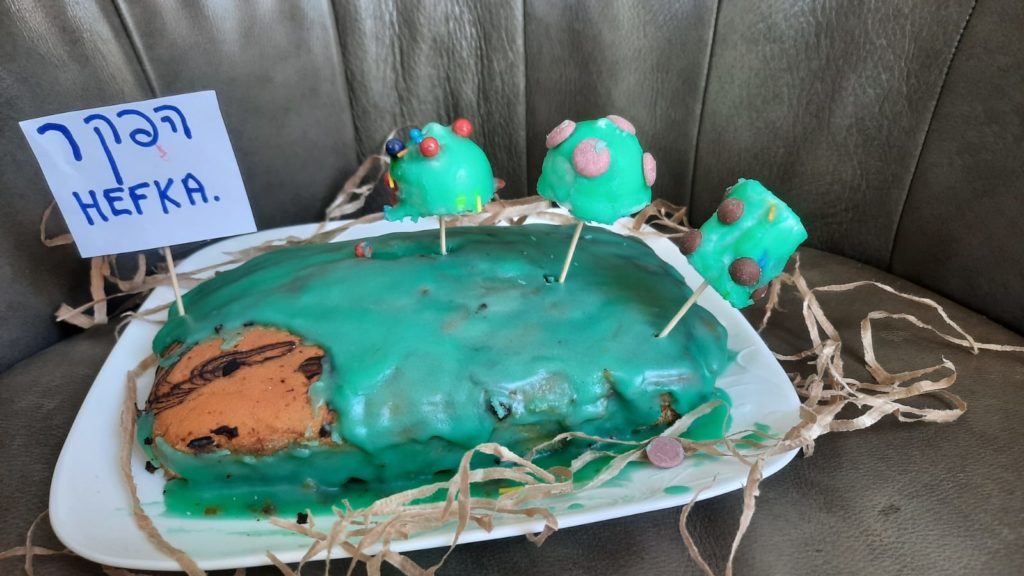
Make a rectangle cake (use your favorite recipe, or buy one). Ice it with green icing. Place Lego trees, or make edible apple trees and put them on the ‘field’ cake. Use pretzel sticks to designate areas that are not planted during the Shmitta year. Make edible trees for your Shmitta field. Take marshmallows, coat them with icing and stick glace cherries of chocolate chips on them. Attach the marshmallow to a pretzel stick and put it on the cake. Make a few ‘trees’.
Make a ‘sign’ on a paper, attach it to a toothpick and put it on the Shmitta cake. The sign says; ‘HEFKA’ (write it in English and/or Hebrew), indicating that anybody can come to the field to help themselves to fruits during the Shmitta year.-This a great conversation piece for the Shabbat table!
We reach the end of the Book of Vayikra this week.
“CHAZAK! CHAZAK! VENITCHAZEIK! Be strong,! Be Strong! And may we be strengthened!”
Shabbat Shalom from Safta Laya!