Pesach thoughts from Safta Laya
Pesach time 2021
The regular reading of Parsha is different this week because it’s Pesach. We reread from Parsha Beshalach about the journey from Egypt through the desert.
They didn’t go directly because Bnei Yisrael had to learn lessons of faith- seeing and appreciating the constant miracles in the desert:, manna, water and the constant protection from the elements. When we read this Parsha again we understand that everything is in G-d’s hands, especially surviving in the desert- which would have been impossible without Divine intervention.
It’s interesting to understand the chronology of events during the seven days after they left Egypt. The Ramban explains ‘with an upraised arm’ – is actually what it was- because Bnei Yisrael left Egypt with banners, songs and celebrations thus proving they did not plan to return to slavery.
The chronolology is as follows:
Bnei Yisrael left Egypt on the morning of the 15th Nissan and the sea split on the 21st Nissan.
15th Nissan: Israel travelled from Rameses to Succoth.
16 Nissan: They travelled from Succoth to Etham.
17th Nissan: They retreated back towards Egypt and encamped at Pi-hahiroth.
18th Nissan: Pharoah’s agents reported that the ‘three days to serve G-d ‘had gone by and the Jews were not returning to their servitude.
19th-20th Nissan: Pharoah organized his forces and pursued the Jews.
21st Nissan: The sea split to save Israel and returned to its place to swamp Egypt (Sforno)
‘Moshe and the Children of Israel chose to sing this song to Hashem’- the Song by the Sea.
Moshe lead the song and all the people sang responsively with him (Sotah 30b).
The whole nation joined in- ‘Am Echad, ve Lev Echad’ – with a new realization that G-d controlled the harmony of creation. The experience was so profound and spiritua. Bnei Yisrael had strong Emunah (faith) in the miracles that Hashem had performed for them and they sang with great harmony. It was truly one of the greatest symphonies of all time!
As Pesach comes to an end, lets all take time to recognize the miracles that are happening around us, appreciate what we have and our families and friends, our nation, and ‘feel’ gratitude and connection with our special nation. Lets sing the ‘song’ of unity and peace’ as feel the symphony of ‘Am Echad ve Lev Echad’.
The Prayer for Dew- Beginning on Pesach…- What is it all about??
On the first morning of Passover, many Jewish communities recite a special prayer called Tefillat Tal, literally “The prayer for Dew.” ‘Morid haTal’,-
What is dew? Can you see it? Can u feel it? Dew is a natural form of water, formed as water vapor condenses. Dew is like the glistening drops. When condensation happens, small water droplets form—dew.
This prayer is said at the beginning of spring, going into summer. We say the prayer for rain, Tefillat Geshem at the end of the holiday of Succot, autumn time, into winter. Both prayers coincide with the changing of the agricultural seasons in ancient Israel. The winter is the rainy season in Israel. Summer is long, dry and hot. In ancient times the regular presence of a tiny bit of dew could mark the difference between a successful harvest season and a poor one. Both prayers reflect the idea that rain and dew are blessings from God. The traditional Ashkenazic practice is to recite Tefillat Tal during the repetition of the Mussaf Amidah on the first day of Passover. Sephardic Jews recite the prayer just prior to the recitation of the silent Mussaf Amidah. It is a special time when the Jewish people pray for another year of life and sustenance which makes us realize how important rain and dew are to the survival of our people.
It is said that rains that fall at the end of Nissan are considered to be a bad sign for the world because the time for the grain harvest has begun and rain will cause the sheaves of grain lying in the field to rot with too much rain. That is why we pray for dew to fall and moisten the crops without harming the grain that is drying.
The text of Tefillat Tal takes the form of a liturgical poem, or a piyyut. It is written by Eleazar Kalir, one of the earliest Hebrew poets who lived in the sixth century of the Common Era. The prayer concludes by praising God “who causes the wind to blow and the dew to fall” and makes three requests: for a blessing, not for a curse; for life, not for death; for abundance, not for famine.
FUN ACTIVITIES
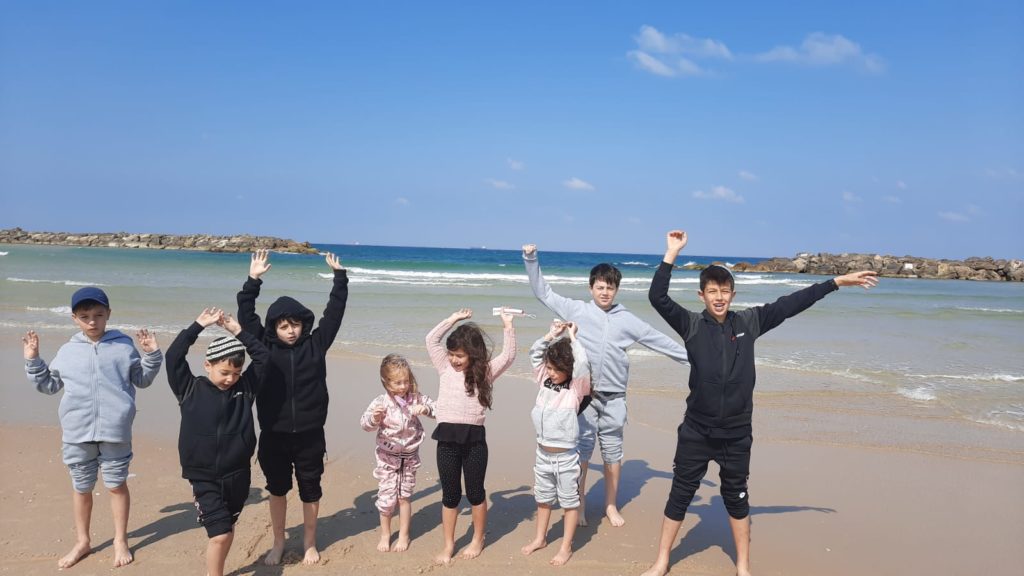
Dew– try and go out early in the morning and see some dew on a blade of grass, or on a leaf. Notice it and touch it, see how it feels…..Take a ‘spray’ with water and spray yourself…..feel the droplets of water on your arm, or face…( (make sure to close your eyes if it is in your face.)… ‘Dew mist’…….- to revive, survive, feel refreshed and renewed.

Sefirot Ha’omer
Between the holidays of Passover and Shavuot, the Omer is counted each evening, signifying our preparation for the receiving of the Torah on the holiday of Shavuot.
The are 49 days from Passover to Shavuot. There are 10 sefirot which G-d created and interacted with the world. They are divided into 2 categories, the upper and lower sefirot.
The upper sefirot are; Chochma , Bina, Da-at.
The 7 lower sefirot are what we focus on during the 7 weeks of Sefirot HaOmer. The sefirot are a mystical revelation of G-d’s character and the way Hashem interacts with the world. The Sefirot are in a sense, G-d’s personality and His behavior and how we perceive it. The sefirot represent our finite understanding of the infinite.
The seven sefirot that we focus on in the 7 weeks, from Pesach to Shavuot are; Chesed, Gevurah, Tiferet, Netzach, Hod, Yesod, and Malchut. They are all mentioned in the verse: ‘To you Lord, belong greatness (chesed) the strength (gevurah), the glory (tiferet), the victory (netzach ) the splendor, (hod) and for all that is in the heaven and the earth is Yours. Yours is the kingdom (Malchut).
Each sefirot is then broken up into smaller parts. For example- ‘chesed she-be-chesed’ (kindness within kindness) gevurah she-be-chesed (boundaries within kindness), tiferet she-be-chesed’ etc.
In looking at all these variants of behaviors, we gain deeper insights, and understandings of Hashem, as well as insights into ourselves. Sefirot Ha’Omer has always been a period of spiritual elevation and self-fulfillment. The Counting of the Omer comes alive, and can really change your life and empower you to achieve a state of spiritual fulfillment and refinement in 49 simple yet profound steps.
In this blog I will focus just on the characteristic of the week and I encourage each person to really try to focus on each day, and turn this period into a time of spiritual growth, concentrating on our relationship with G-d, with others and with ourselves.
In counting the days, make the days count!
Week 1- Chesed. ( Kindness) Chesed means kindness. It also means ‘ greatness’ (gedulah) because Hashem is constantly doing chesed even though the world might not deserve it. The Sages tell us that the Torah begins and ends with kindness. Chesed in the Torah is personified by our Patriach, Avraham. His life was dedicated to caring about others. He invites everyone into his tent which is open on all four sides. Chesed is represented by the right hand. Acts of chesed should be done with the right hand. Chesed is also like water, it flows in all directions without distinction. Everyone is connected to everyone else through Chesed. This is the reason why we should show kindness to each other.
FUN FOODS
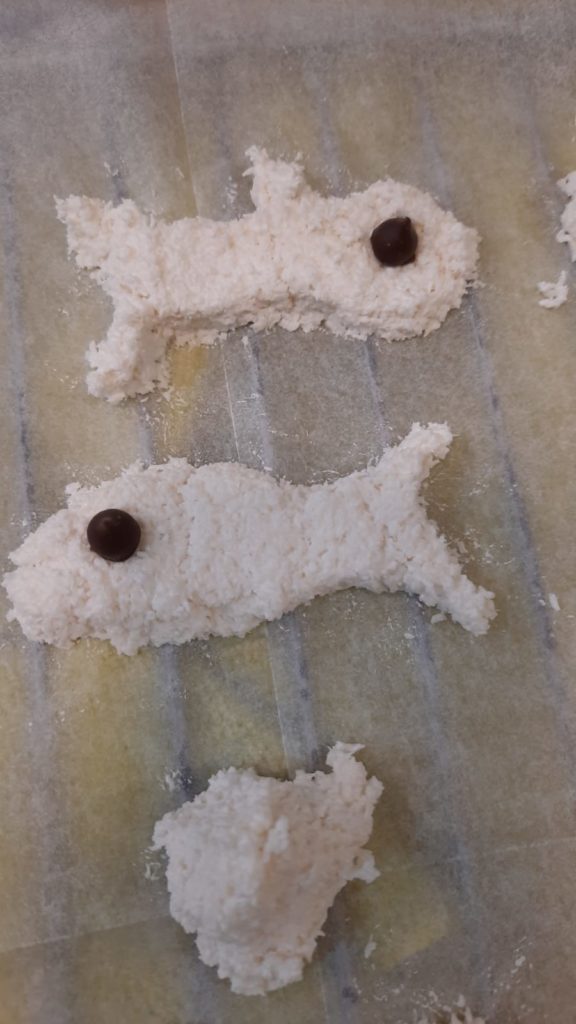
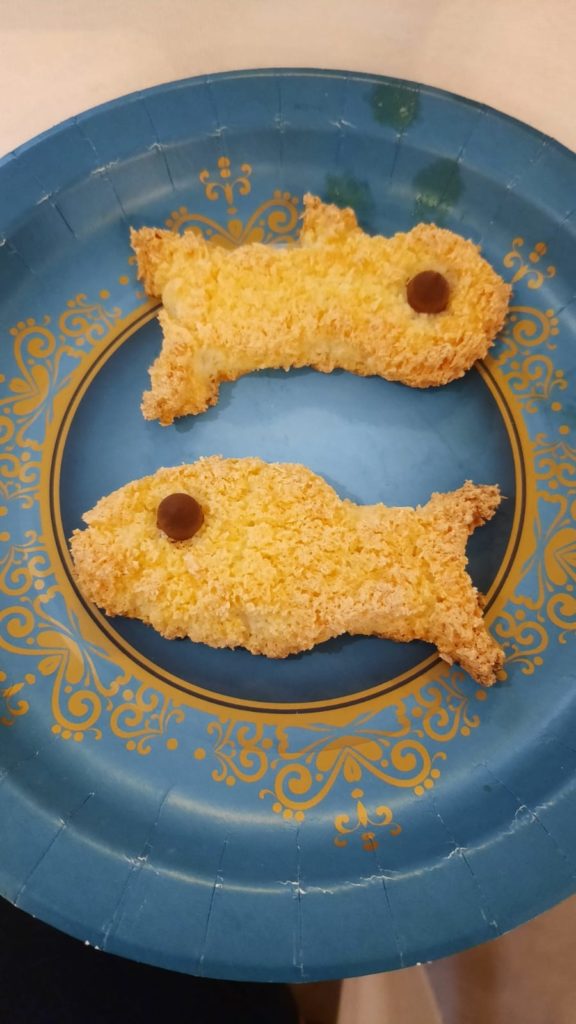
Pesadikah Macaroons in the shape of Fishes- ( for a change!) thinking about Parsha Shemini next week, and incorporating Pesach this week.
Ingredients; 2 egg whites, ¾ cup of sugar, 2 cups of dessicated coconut,1/4 tsp salt. 1 tsp vanilla(optional). Preheat oven to 350 degrees F. Beat egg whites in a bowl until stiff. Slowly add sugar, beat in salt and vanilla.Stir in coconut by hand until well mixed. Put spoon fulls onto a baking tray with baking paper. Bake for approximately 20 minutes. ( until set and delicately brown) Turn off oven and leave macaroons to cool in the oven ( or overnight)
Tuna Matza Lasagne – great for last days of Pesach- family favorite!
Wishing you a great rest of Pesach Sameach,- Shabbat Shalom
Love from Safta Laya
P.S Check out this week’s video: https://youtu.be/9SnOFCnuyJU